

Mars does not wait for events to resolve themselves. It intervenes, often before others have finished explaining what needs to be done.
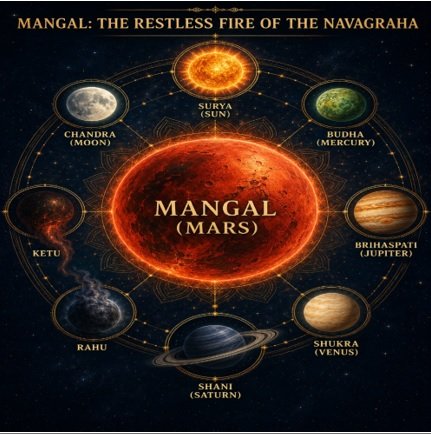
In Vedic astrology, Mangal, or Mars, is the fiery planet of action. It signifies blood, bone marrow, muscles, physical strength, courage, weapons, warfare, competition, command, land and the instinct to confront danger.
It governs the body’s capacity to act and the mind’s urge to respond. Strong and disciplined, Mars produces bravery, stamina, initiative and leadership. Uncontrolled, the same force may manifest as anger, aggression, haste and disproportionate reaction.
Mars is, therefore, best understood as “utaavli urja”, energy impatient to express itself. It does not merely contemplate danger; it moves towards it. It dislikes delay, prolonged consultation and elaborate preparation. It may begin acting before the instructions are complete, trusting that courage and improvisation will resolve whatever emerges along the way.
In an emergency, this instinct can save lives. In a sensitive operation, it can alter the entire outcome.
Those strongly influenced by Mars are often in a great hurry. Note-taking, written planning, risk assessment and lists of dos and don’ts may appear to them as unnecessary delays. Their philosophy is simple: “Let us reach the spot first; we shall decide the rest there.”
This may explain (Lord) Hanuman’s special place in the emotional world of the police. Across northern India, Hanuman temples stand within numerous police stations, almost as naturally as the armoury and parade ground. Policemen seek from him not merely physical strength, but the courage to enter situations from which everyone else wants to escape.
Goddess Sita was Lord Rama’s wife, and demon king of Lanka- Ravana had abducted her. Hanuman was related to neither by blood. Yet he crossed the ocean and entered the enemy’s kingdom. Why?
Because courageous power cannot remain a spectator when injustice occurs.
That is also the essential instinct of policing. Two people quarrel, but the police intervene. A woman is assaulted within her home, but the police enter what others may call a private matter. A child disappears, a shop is looted or a neighbourhood erupts in violence, and an officer unconnected with either party assumes responsibility for restoring order.
The victim’s fear becomes his concern; society’s conflict becomes his duty.
The policeman, like Hanuman, repeatedly enters other people’s battles.
Yet the Lanka episode contains a deeper and more enigmatic lesson. Hanuman had been sent to locate Sita, ascertain her condition and return with reliable information. He was not sent to burn Lanka.
But the mission escalated.
Hanuman destroyed the Ashoka grove, confronted Ravana’s forces, entered the royal court and, when his tail was set aflame, transformed his punishment into a devastating counterstroke. A reconnaissance mission became an armed encounter, psychological warfare and, finally, a burning city.
Sent to search, he set Lanka ablaze.
That is Mangal in its purest form: courageous, decisive and effective, but not always containable within the original mandate.
There is something unmistakably Martian in the subordinate who begins acting while the senior officer is still explaining the assignment. Before the order is complete, the vehicle has been summoned, the force assembled and the operation launched. The objective remains unwritten, the limits undefined and the consequences unexamined.
The Mars-driven mind believes that hesitation is weakness and that every problem will reveal its solution once action begins.
Such initiative may save precious time and prevent a tragedy. It may also send a police party into the field with immense energy but inadequate clarity about its authority, purpose or exit strategy.
An officer sent merely to verify a complaint may begin detaining suspects. A force ordered to disperse a crowd may pursue it far beyond the trouble spot. A routine enquiry may become a public confrontation. A preventive deployment may turn punitive. The intention may be sincere and the immediate result impressive, yet the excess can embarrass senior officers, the government and the institution itself.
Mars often completes the mission, but occasionally rewrites it.
This does not diminish Hanuman’s greatness. His actions arose from courage, intelligence, loyalty and absolute commitment to Rama’s cause. Burning Lanka also conveyed a powerful warning to Ravana about the force standing behind Rama.
Nevertheless, the episode illustrates why extraordinary energy must remain anchored to a clear purpose. Initiative may save a situation; initiative without restraint may enlarge the conflict it was meant to contain.
The Mahabharata offers another contrast through Bhima and Duryodhana. Neither is a direct personification of Mars, yet both embody strikingly Martian qualities. Both are immensely strong, fearless, competitive, quick to anger and formidable masters of the mace. Their rivalry demonstrates how similar physical power can produce entirely different consequences depending upon the purpose governing it.
Bhima’s strength is largely directed towards protecting his family, answering humiliation and resisting oppression. His anger, though fierce and sometimes excessive, serves a cause greater than himself.
Duryodhana possesses comparable courage, endurance and warrior skill, but his power becomes increasingly governed by rivalry, entitlement and wounded pride.
Bhima represents force serving a cause. Duryodhana represents force overtaken by ego.
The distinction is crucial for policing. The uniform confers authority, just as the mace gave both warriors power. But authority alone cannot determine how that power will be exercised. Guided by duty, the officer becomes a protector. Governed by anger, prejudice, ambition or personal pride, he may begin to resemble the aggressor he was meant to restrain.
Kartikeya represents another dimension of martial energy. If Hanuman symbolises courageous intervention and spontaneous initiative, Kartikeya, commander of the divine forces, represents training, intelligence, formation, strategy, hierarchy and command.
Hanuman leaps; Kartikeya deploys.
Effective policing requires both. It needs Hanuman’s courage to respond without fear and Kartikeya’s discipline to define the objective, assess the terrain, allocate responsibility, anticipate consequences and prepare an exit strategy.
One creates momentum; the other ensures that it reaches the intended destination.
Astrology conveys the same warning symbolically. A strong and well-placed Mars may bestow courage, stamina, initiative and leadership. When severely afflicted, particularly through difficult associations with Saturn, Rahu or Ketu, courage may become cruelty, impatience may become rashness, authority may become intimidation and bravery may descend into notoriety.
The same hand that protects may begin to oppress.
The Hanuman temple within a police station, therefore, carries a meaning deeper than ritual. Hanuman is not invoked merely to give the police strength to overpower criminals. He also reminds the wielder of force that strength is sacred only when exercised for a just cause, in defence of the vulnerable and within the discipline of a higher duty.
Mars supplies the fire. Hanuman supplies devotion. Kartikeya supplies command.
Police work inevitably requires utaavli urja. A delayed response may cost a life. An officer cannot deliberate indefinitely before rescuing a child, stopping an assault or confronting an armed offender.
But urgency does not eliminate the need for clarity.
A few moments spent understanding the objective, recording critical instructions, defining the dos and don’ts and anticipating consequences may prevent hours of confusion and years of institutional embarrassment.
The finest officer must carry fire in the limbs, law in the mind, strategy in the head and restraint in the hand.
Mars says, “Enter the conflict.”
Bhima says, “Use your strength against injustice.”
Duryodhana warns, “Never allow strength to become the servant of ego.”
Kartikeya says, “Plan, organise and respect command.”
Hanuman says, “Act fearlessly—but never forget the purpose for which you were sent.”
For when Mangal wears khaki, the challenge is not merely to awaken its tremendous energy.
The greater challenge is to direct it, discipline it and know where it must stop.
