

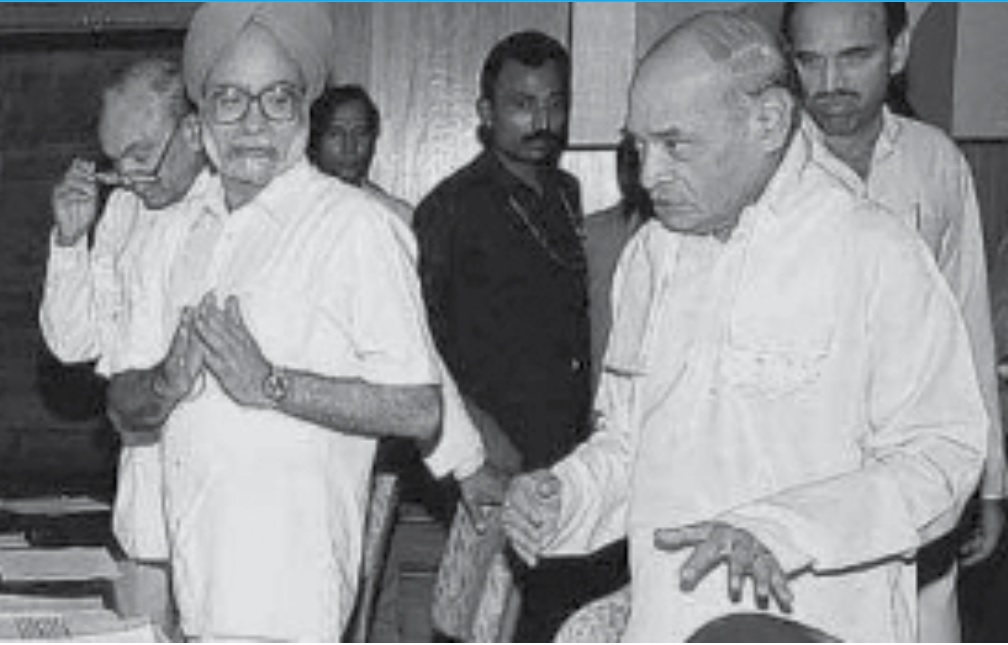
The economic liberalisatiion not only bailed the country out of the crisis but also helped the country give a boost to economic activities and open its door to foreign direct investment (FDI) to an unprecedented level.
Bhopal: The then Prime Minister of India Narasimha Rao sought his finance minister Dr Manmohan Singh’s resignation letter before implementing Dr Singh’s economic liberalisastion policy in the country.
The economic liberalisation policy, a brainchild of internationally acclaimed economist Dr Manmohan Singh, came at a time when the country was reeling under an economic crisis and “Inspector Raj” was a big hurdle in the way of progress and development of the country.
The economic liberalisatiion not only bailed the country out of the crisis but also helped the country give a boost to economic activities and open its door to foreign direct investment (FDI) to an unprecedented level.
However, before the policy was introduced the then Prime Minister Narasimha Rao was perhaps not too much convinced about its positive result. He did want an out of box idea from Dr Manmohan Singh to ensure desired progress and development of the country but was not too sure if the policy of economic liberalisation would yield a positive result.
According to national English daily Hindustan Times’ political editor Vinod Sharma as he shared his opinion on Dr Manmohan Singh with certain TV news channels after his demise, Narasimha Rao had Dr Manmohan Singh’s resignation letter with him. He had made it clear to Dr Singh that he (Rao) would accept his resignation letter immediately if the policy of economic liberalisation didn’t work.
However, Narasimha Rao didn’t need to accept Dr Singh’s resignation as the policy proved a panacea for the country at that time and proved a super catalyst for massive economic activities across the country. Had the economic liberalisation policy failed Manmohan Singh would perhaps not been considered for the PM post too later in the course of time.
Though there are often debates in the academic circles and otherwise if the policy really helped the masses in the country, importance of the policy can be gauged from the fact that it continues to be followed even three decades after it was first introduced.
