

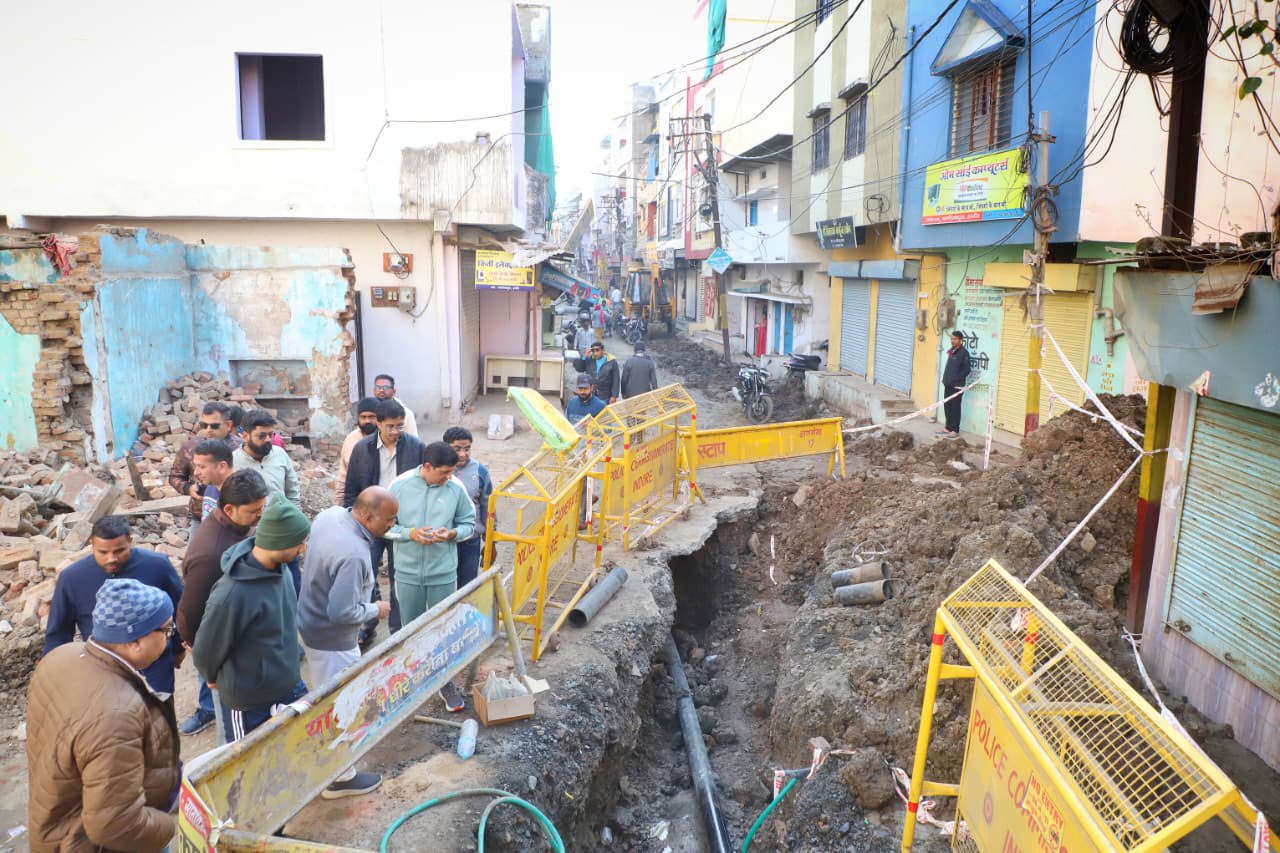
Despite drinking water being sourced from surface water bodies such as rivers, reservoirs, and dams, repeated water quality assessments revealed the presence of pathogenic contaminants including faecal coliform, E coli, Vibrio species, and protozoa in treated water supplied for human consumption.
Such contamination clearly indicates sewage intrusion into potable water distribution systems, a situation that could not have arisen without persistent infrastructural failures, poor maintenance, and noncompliance with established public health engineering norms.
-Justice Sheo Kumar Singh and EM Ishwar Singh, NGT, Central Bench
Bhopal, January 15, 2026
Taking a serious note of Indore tragedy that has claimed as many as 23 lives so far National Green Tribunal (NGT) has termed it as a serious governance failure and has asked the government to take immediate measures to ensure safe water to people across the state, as per the NGT central bench’s order copy.
The bench directed the state government and municipal corporations in all the districts across the state to develop an water app to receive citizens’ complaints to address it and take measures to check pollution of water bodies in the state- dams, ponds, wells and bawris- not being used for immersing idols.
In late December 2025 and early January this year, a severe water contamination crisis struck Bhagirathpura locality in Indore, leading to a major health emergency. Seepage from a sewage line into damaged drinking water pipes and local borewells caused a widespread diarrhoea and vomiting outbreak, affecting over 2000 residents. The affected were rushed to hospitals by their family members but as many as 23 died during treatment so far. Many patients are still in intensive care unit of hospitals.
While officials initially confirmed only 6 deaths, chief secretary Madhya Pradesh during a hearing in High Court on a petition acknowledged 15 deaths due to contamination of water and six other deaths not related to contamination. However, as per local media reports, as many as 24 persons affected have died so far.
The NGT order came on Thursday (January 15, 2026) during a hearing on two different applications filed by Rashid Noor Khan and Kamal Kumar Rathi.
As per the order copy, The bench of NGT comprising Justice Sheo Kumar Singh and expert member Ishwar Singh said in its order, “The crisis exposed serious governance failures, including delayed emergency response, inconsistent disclosures regarding the number of affected persons and fatalities, and lack of transparency and accountability.”s
The bench further said the incident was not an isolated occurrence but reflective of a broader and systemic failure in urban water management, as similar conditions and contamination risks were reported in other cities of Madhya Pradesh such as Bhopal, Khargone, Ujjain, Gwalior, Rewa and Satna, demonstrating a continuing and state-wide environmental and public health threat.
Alerting the state government regarding ‘continued existence of unsafe water infrastructure and absence of uniform safeguards’, the bench said that the situation posed an imminent risk of recurrence of similar water-borne epidemics.
Justice Singh and the expert member Ishwar Singh underlined in their order that contamination of drinking water is a clear violation of the Water (Prevention and Control of Pollution) Act, 1974, the Environment (Protection) Act, 1986, and the constitutional guarantee of the right to life under Article 21, which includes the right to clean and safe drinking water.
The NGT bench directed the state government and municipal corporations in all the districts to develop a water app for hearing complaints and supervising the adequate water supply to the citizens.
“The Municipal Corporation shall give wide publicity about the app and shall ensure its 24×7 hours workability”, said the bench.
Regarding contamination of water the bench said, “The issue has assumed alarming proportions in light of recent incidents of mass illness and loss of life attributed to consumption of contaminated drinking water, which have exposed serious deficiencies in water supply infrastructure, sewerage management, monitoring mechanisms, and regulatory oversight.”
It said despite drinking water being sourced from surface water bodies such as rivers, reservoirs, and dams, repeated water quality assessments had revealed the presence of pathogenic contaminants including faecal coliform, E coli, Vibrio species, and protozoa in treated water supplied for human consumption.
“Such contamination clearly indicates sewage intrusion into potable water distribution systems, a situation that could not have arisen without persistent infrastructural failures, poor maintenance, and noncompliance with established public health engineering norms”, observed the bench.
It said across multiple urban centres, drinking water pipelines and sewerage lines were laid in close proximity, often intersecting or running parallel to each other. In several instances, drinking water pipelines were laid below sewer lines or drains, increasing the risk of contamination in the event of leakage, pressure fluctuations, or pipeline damage.
The bench observed that intermittent water supply systems further aggravated the situation by creating negative pressure within pipelines, thereby facilitating ingress of contaminated water.
“The gravity of the issue is compounded by the lack of continuous water quality monitoring, inadequate maintenance of overhead tanks and sump wells, and failure to adopt preventive surveillance measures, despite clear guidance provided under national technical manuals issued by the Government of India”, said the bench.
The statutory framework under the Water (Prevention and Control of Pollution) Act, 1974 casts specific obligations on local authorities and regulatory bodies to disclose contamination incidents, take immediate preventive action, and prevent pollution of water resources. However, repeated instances of delayed disclosure, reactive response, and continued supply of contaminated water demonstrate violations of sections 31(1), 31(2), 42 and 43 of the Act.
The recent regulatory notification dated 10.11.2023 issued by the Ministry of Environment, Forest and Climate Change further reinforces the requirement of transparency, monitoring, and accountability in matters relating to drinking water quality, stated the bench.
The other instructions from the NGT bench to the state government and the municipal corporations are as follows:
(i) Eliminate transmission loss of water by taking all measures such as laying pipelines (if not already laid), repair leakages etc.
(ii) Remove all encroachments of and around all the water bodies including those from where the water is drawn and stop illegal infiltration by all class of persons.
(iii) Municipal Corporation shall keep all overhead water tanks and sumps utilized for supplying potable water functional all times and get them periodically cleaned and chlorinated.
(iv) Municipal Corporation to work out the scheme to stop construction work during summer seasons between March to July each year and regulate water supply ward wise during these months to ensure that each of the citizens gets water for consumption and other use during these months in each alternate days.
(v) Municipal Corporation to regenerate water for supply to the locality situated around public Wells/Bawaris and the tubewell.To achieve the same it shall layout a plan to be included in the water app.
(vi) Municipal Corporation in association with the State Government shall prepare comprehensive water harvesting scheme and implement the same rigorously and make provisions
in the bye laws making the non- compliance by the individuals, establishment both State Government/ Union Government, all private and public institutions including Schools/ Colleges, punitive.
(vii) Municipal Corporation shall prepare a comprehensive scheme to supply water through tankers stipulating precondition to meet out the shortage as and when the occasion so arises.
(viii) Municipal Corporation to ensure chlorination of water supplied for domestic purpose.
(ix) Municipal Corporation shall lay down the stipulations such as Do’s and Dont’s regarding domestic and non-domestic water use.
(x) Municipal Corporation shall meter all domestic and non-domestic water supply.
(xi) Municipal Corporation and the State and its functionaries shall ensure that all the dairies having more than two milking cattle be moved outside the city at a place earmarked for them within 4 months from the date of communication of this order.
(xii)Municipal Corporation shall regularly take recourse to pre-chlorination, post-chlorination and aeration process.
