

There are certain stories that women cover—and can cover—more effectively than others.
-Consulting editor Hindustan Jayanti Ranganathan in her speech to mark the 15th Bhuvan Bhushan Deolia Memorial Lecture
Bhopal:
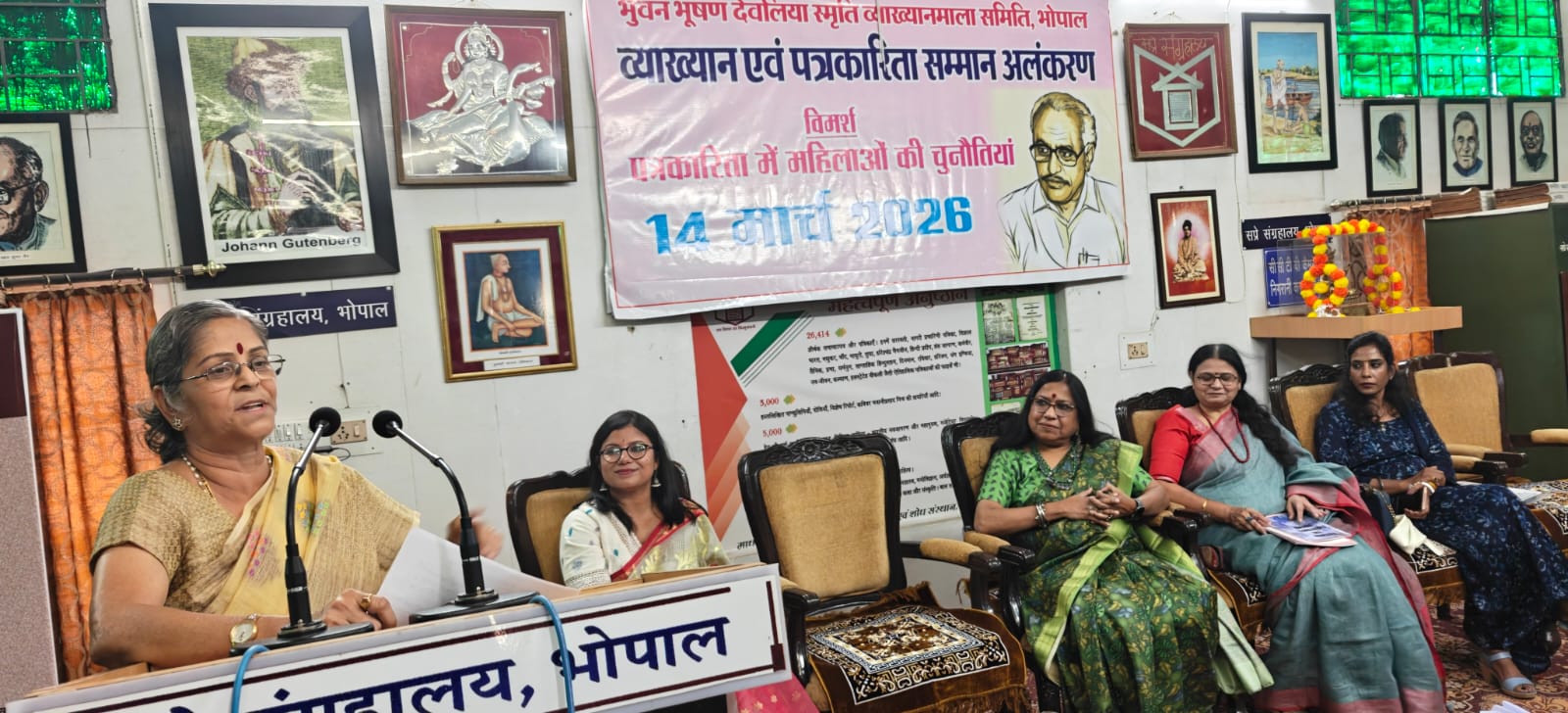
Exhorting woman journalists in India to overcome challenges they face in the field of journalism with hard work and dedication noted national journalist Jayanti Ranganathan said here on Saturday journalism can never be seen through a prism of glamour. For, if glamour takes precedence in journalism there is every possibility of truth being obscured.
Jayanti Ranganathan who is a consulting editor with national Hindi daily Hindustan was speaking on “Challenges to women in journalism” as a key speaker to mark the 15th annual Bhuvan Bhushan Deolia Lecture Series organised at Madhavrao Sapre Sangrahalaya Evam Shodh Sansthan here on Saturday.
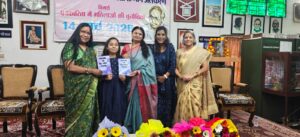
Senior journalist Deepti Choursia was honoured with state level Bhuvan Bhushan Deolia Patrakarita Samman on this occasion.
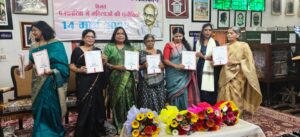
A good number of journalists, authors and disciples of late Bhuvan Bhushan Deolia from Bhopal, Sagar and Vidisha were present on the occasion.
In her address Jayanti Ranganathan said she left her banking job to pursue a path of creative expression. At the time when journalism was a male-dominated profession she received complete support from her family.
She said she entered the field of journalism not for the sake of glamour but with a sense of mission.
On her experience in the initial days of journalism when she was working with Dharmayug, a renowned national magazine published in Hindi with massive readership, Jayanti Ranganathan said when notorious criminal Charles Sobhraj escaped from a prison, the then chief editor of the magazine Dharamvir Bharati, assigned her to go and interview the criminal.
She said she ventured into the notorious ‘Kabaad Gali’ to cover the story. Her work earned her respect and recognition.
Ranganathan said one must be prepared to overcome challenges.
“If you show signs of weakness or share your personal domestic problems colleagues may withhold their cooperation”, she advised the woman journalists.
She said with the advent of electronic media, the perceived glamour of the profession attracted an increasing number of young women.
There are certain stories that women cover—and can cover—more effectively than others, she said and added, for instance, she had reported on stories involving gender transition and the LGBTQ community.
Giving a piece of advice to woman journalists Ranganathan said, “For news coverage, one is no longer solely dependent on newspapers or television channels. The possibilities are now as boundless as the open sky. Woman journalists are currently doing excellent work. There are ample opportunities for those who are committed to working consistently.”
Director research, Madhavrao Sapre Newspaper Sangrahalaya Evam Shodh Sansthan Dr Mangla Anuja said, “In India, the first instance of female journalism appeared in 1835. Thus, in the field of journalism, women in India are not significantly lagging behind their global counterparts.”
She said, “Woman journalists encounter discrimination in the workplace—being regarded as inferior and denied promotions—and have often received no cooperation from male journalists.”
In her address Deepti Choursia said,
“Woman journalists face even greater challenges in the field of journalism. The challenge lay in navigating a dual identity: being a woman, and being a journalist. How does one move forward?”
She said, “In newsrooms prime beats are often assigned to male journalists. Furthermore, cameramen are often reluctant to accompany female reporters during field coverage.”
She said gender discrimination remained the single greatest challenge for woman journalists.
For instance, she said, in smaller towns when high-profile leaders visited, female reporters were often not assigned to cover the event, as they were frequently underestimated.
“At home, a young woman faces significant hurdles when choosing to pursue a career in journalism. With struggles on three fronts—family, fieldwork, and gender inequality—many are ultimately compelled to abandon the profession”, she added.
She asked why was it that a photograph of a female rape survivor invariably depicted her with her head bowed in shame? Why not show her fighting back?
“These entrenched perceptions are, however, slowly beginning to crumble. If a journalist were simply regarded as a journalist—irrespective of gender—gender inequality would cease to exist. Just as women have achieved independence in exercising their right to vote, female journalists, too, will eventually be liberated from the constraints of gender bias”, she opined.
Director Nirala Srijan Peeth, Madhya Pradesh government, Dr Sadhna Balwate said in her speech, “In the field of journalism, the sense of “mission” has diminished due to “glamour.”
While the inherent challenges may have lessened, the representation of women in the field of journalism remains strikingly low—standing at a mere 0.23%.
At Dainik Jagran, for instance, she said, there are at most two (female) editors, and notably, women are not being appointed at editorial positions. “Journalism and literature are complementary disciplines. However, the literary element within journalism has significantly diminished. A harmonious balance between the two is essential, accompanied by a strong emphasis on maintaining the lucidity and elegance of journalistic language”, she said.
She said, “Women possess innate qualities conducive to journalism—specifically, a heightened sensitivity and a natural ease in eliciting information from others. It is imperative to channel one’s journalistic experiences into literary works.”
