

The first 1000 days of a child shape his future and development. If a child can’t get required nourishment during this period chances are he will suffer from problems lifelong.
Bhopal:
Emphasising the need to adopt a holistic approach to address the issue of public health Dr Sunil Kaul is of the view there are too many factors including domestic violence, hate-mongering and caste discrimination which affect it adversely across the country.
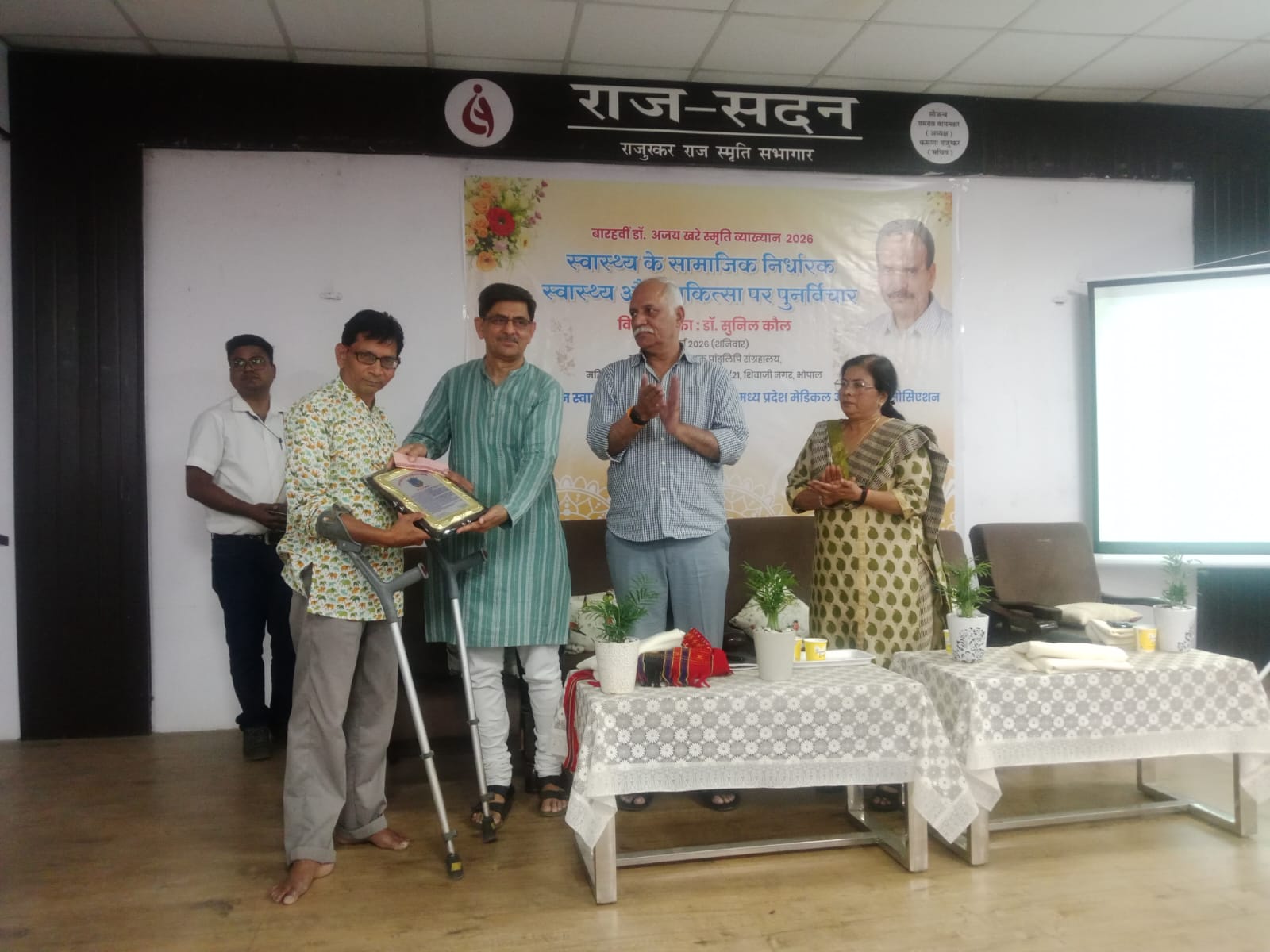
Public health expert Dr Sunil Kaul was delivering the 12th Dr Ajay Khare Memorial Lecture at Bhopal on the theme “Social Determinants of Health: Rethinking Health and Medicine” organised jointly by Jan Swasthya Abhiyan, Madhya Pradesh and Madhya Pradesh Medical Officers Association.
“Merely looking at doctors centric health centres to understand and strengthen the public health is a flawed approach. For, there are too many other factors in society which affect badly the public health in our country and need our attention”, said Dr Kaul, an alumnus of Armed Forces Medical College, Pune, who served the Army Medical Corps before deciding to work on public health particularly in rural Assam.
Underlining the importance of first 1000 days of a child which, he said, shaped his future and development Dr Kaul said if a child couldn’t get required nourishment- physically and mentally both- during this period chances were he would suffer problems lifelong.
Highlighting the serious issue of malnutrition in Madhya Pradesh, he questioned whether the current Aanganwadi model was adequate or it needed reform.
He emphasised the need for deeper discussion on nutrition and care during the first 1000 days of life—from pregnancy to the first two years of a child’s life.
Dr Kaul described violence against women as a major public health crisis.
According to government data, he said, nearly 35,000 women died every year due to dowry-related or domestic violence, often by burning.
“Non-governmental estimates suggest the number could be as high as 75,000 deaths annually”, he said.
He emphasised that alongside efforts to reduce maternal mortality, violence against women must also be addressed as a serious public health concern.
Citing a survey conducted in Assam, he said 58% of men admitted to committing some form of violence against their wives, underscoring that violence was not merely a women’s issue but a broader societal and public health concern.
He further stated that hate, caste discrimination and communal violence also had profound impact on public health.
In 2020, he added, a leading public health institution in the United States also recognised hate as a public health issue.
He said, “Public health should be seen in the broader context of social justice, equality, and social conditions.”
Referring to an important research on tuberculosis (TB) conducted by Dr Anurag Bhargava, he highlighted the scientific link between TB and hunger.
“Today, it is widely accepted globally that along with medicines, adequate and nutritious food is essential for the effective treatment of TB. Despite this understanding, nearly 400,000 people continue to die of TB every year in India. Earlier, the target was to reduce TB deaths by 50%, but currently only around 25% reduction has been achieved, even though TB medicines are available free of cost”, he said.
Dr Kaul stressed that saving lives through public health requires not only increased health budgets but also stronger investments in nutrition, social security, education and equality.
He also expressed concern about the growing commercialisation of education and competitive examinations, citing the example of exams like NEET.
“The path we are moving on is a path of deviation,” he said.
Speaking in the context of the Sustainable Development Goals (SDGs), he noted that the original vision of health systems was equal care for all, but increasingly the reality was that without money, access to treatment became difficult. “This situation leaves both the rich and the poor feeling insecure”, he stressed.
He emphasised the need to rise above caste and class-based discrimination and strengthen people’s autonomy and dignity.
Dr. Kaul also identified climate change as a major public health challenge, warning that Himalayan glaciers were melting rapidly and several studies indicated that their size could significantly decline in the coming years.
“We can hope for the best, but we must prepare for the worst,” he said.
He advocated for a decentralised health model and strengthening community-based health systems. He suggested that ASHA workers could be trained further to provide medicines and basic primary care so that community-level health systems became more resilient during crises.
Raising concerns about the pricing of medicines, he said that many drugs were sold at prices several times higher than their manufacturing costs, which contributed to inequalities in the health system.
He also emphasised that public health should not remain confined to doctors alone, and must involve experts from anthropology, psychology and other social sciences.
Concluding his lecture on a hopeful note, he quoted:
“Ek zindagi dhoondh lao, Wo bheegi hui chingaari dhoondh lao.”
Earlier, introducing the programme, Amulya Nidhi stated that over the past twelve years, several leading public health experts from across the country had spoken on major public health challenges from this platform.
On this occasion, Dr C Sathyamala, Vivek Pawar, and posthumously late Dr CM Gulhati were honoured with Jan Swasthya Samman.
In his presidential remarks, Dr Rajneesh Joshi said every individual’s behaviour and social context influenced his health.
“Health, therefore, cannot be viewed only in terms of doctors, medicines and treatment. It is closely linked with education, empowerment, political will and poverty”, he added.
Representing Madhya Pradesh Medical Officers Association, chief medical and health officer (CMHO), Indore Dr Madhav Hasani said, “The torch lit by Dr. Ajay Khare in the field of public health must be carried forward collectively.”
He said although he (Dr Hasani) currently held an administrative position, his commitment to public health remained unchanged.
Recent developments in Indore, he added, underlined the need to address not only treatment but also the broader social and environmental determinants of health.
