

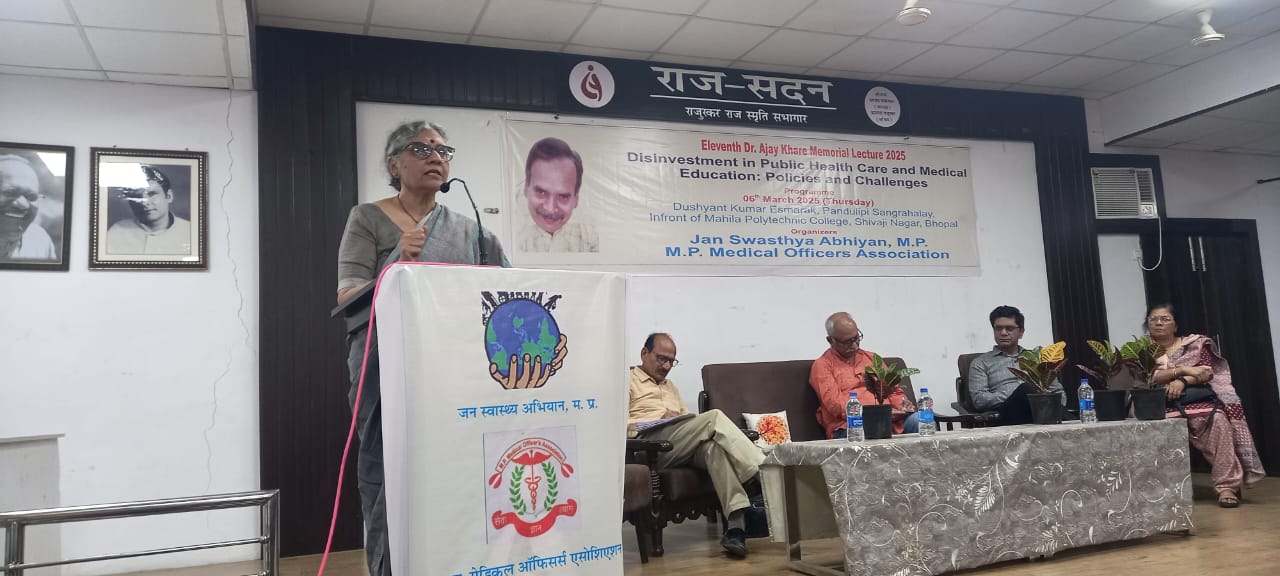
Based on the advice of global consulting groups, the 2022 NITI Aayog document has given guidelines for handing over district hospitals to private stakeholders setting up medical colleges, on the basis of which a serious attempt is being made to privatize and commercialise health services and medical education: Dr Rama V Baru
Bhopal: Serious attempts are being made to privatise and commercialise health services and medical education in the country which will affect the public healthcare system adversely.
This was opined by Dr Rama V Baru as a keynote speaker in her lecture on “Disinvestment in Public Health Care and Medical Education: Policies and Challenges” organised jointly by Jan Swasthya Abhiyan, Madhya Pradesh and MP Medical Officers Association to mark the 11th episode of Dr Ajay Khare Memorial Lecture Series here at Dushyant Kumar Memorial Manuscript Museum on Thursday.
Dr Rama V Baru is retired professor of Social Medicine and Community Health Centre of Jawaharlal Nehru University, New Delhi.
Elaborating her views she said, “Based on the advice of global consulting groups, the 2022 NITI Aayog document has given guidelines for handing over district hospitals to private stakeholders setting up medical colleges, on the basis of which a serious attempt is being made to privatize and commercialise health services and medical education through Public-Private Partnership.”
She said the proposal to hand over district hospitals and community health centres (CHCs) for partnership with private medical colleges would break the referral system necessary for a well-functioning public health system.
Initiating the topic Prof (Dr) Rakesh Malviya of Gandhi Medical College, Bhopal said, “It is the moral responsibility of the government to provide affordable and quality health and education to the public. That’s why subjects like health, education and law should be under the government only.”
Dr Malviya who was special guest in the programme shared his experience on the government’s decision to give district hospitals to private stakeholders he said the collective efforts of Madhya Pradesh Medical Federation and everyone forced the government to change its decision.
He said it was only through collective efforts that public health services could be strengthened.
The programme was chaired former additional secretary, Ministry of Health and Family Welfare, government of India Dr Manohar Agnani. He was welcomed by Subhash Sharma and introduced by Dhirendra Arya.
The keynote speaker was welcomed by Jan Swasthya Abhiyan partner Aarti Pandey and introduced by Abhiyan partner Amulya Nidhi.
Dr Rakesh Malviya was welcomed by Rakesh Chandore and introduced by Dr Madhav Hasani. Dr Shashi Khare was welcomed by Ashish Pare of Madhya Pradesh Vigyan Sabha.
The program was conducted by SR Azad and vote of thanks was given by Dr Madhav Hasani of MP Medical Officers Association.
Jan Swasthya Abhiyan’s SR Azad, Amulya Nidhi and selection committee member Dr Anant Bhan informed that this time Jan Swasthya Samman 2024 was being given to two active colleagues working in the field of public health at the grassroots level.
Later, public health expert Dr Ghanshyam Das Verma and environmental health issues expert Kailash Meena were awarded “Jan Swasthya Samman 2024” during the programme.
Dr Ghanshyam Das Verma has worked on health issues with tribal communities in Jhabua where he trained women health workers and managed the RCH programme for nearly 10 years. For the last two decades, he has been working on silicosis and its impact on health of people in Madhya Pradesh and Uttar Pradesh.
Kailash Meena has been fighting against illegal mining in the Aravalli Hills of Rajasthan for over three decades and protecting marginalised communities and ecosystems, as per Jan Swasthya Abhiyan.
